
Unit 01, Assignment 02

Uncredited: The Lost Composers of Western Classical Music (1700-1900)
Page of Contents:
- Continued Experimentation
- A New Set for Female Composers
- Developing the Titles in Books
- Updated Writing Response
Week 01
Getting Started
For cataloguing, I selected 16 titles from the “Libretti and Operatic Scores” set of rare printed/handwritten music discovered over time, from the Harvard Digital Collection. Western printed music possesses a distinctive and historical language for codifying abstract sonic details and technique markers, great for cataloguing and understanding their relationship with their work. This was my first point of interest.
However, as music documentation advanced significantly and gained popularity with the invention of the printing press after the 15th century, “printed” music started to adopt the same nuances present in the publishing industry.
I wanted to explore the intersection of publishing and music industry, particularly in the metadata of these “documents.”
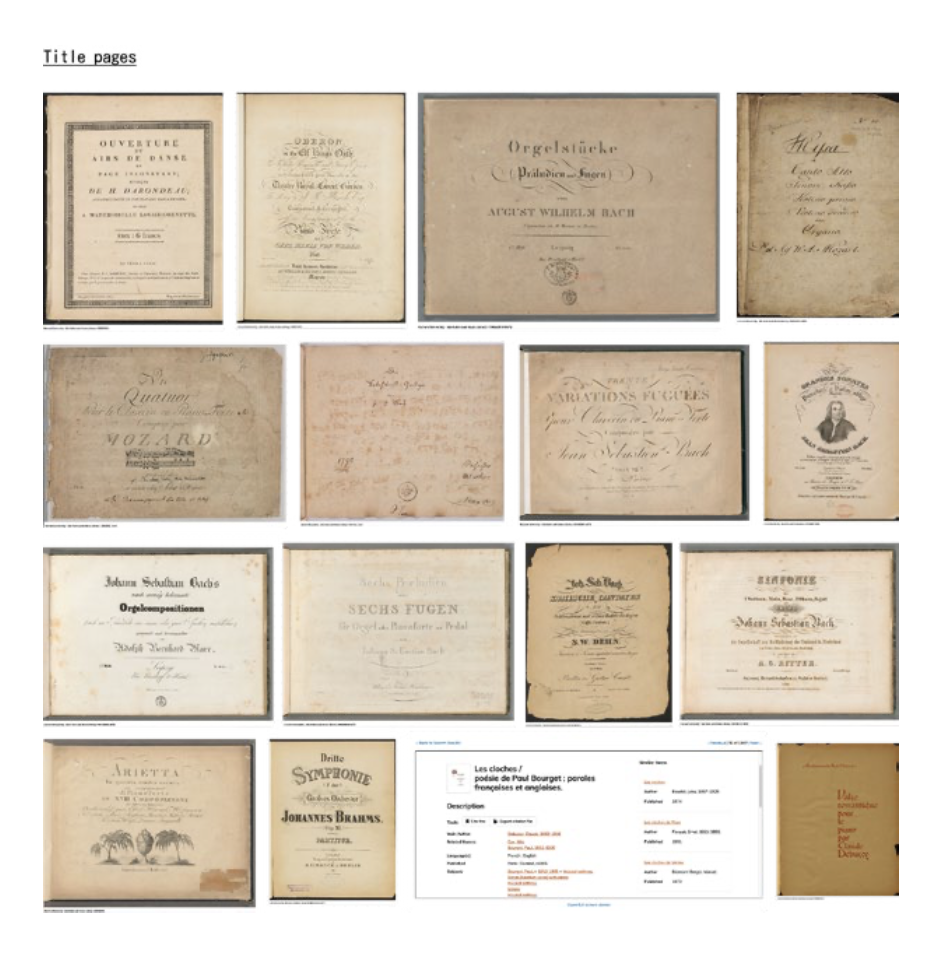
Explorations
I began analysing the set through their materiality, format, language, year of production and authorship. It started to create a clearer picture of the industry at the time.
Through analysing format, it became clear how accessibility to printed music increased through the 18th and 19th century, as did their production quality. With increase in etching and letterpress printing, music production started to develop a strong visual language on not only the contents of the book, but also on its fringes and covers.
Books, at the time were bound after purchasing so the title page remained a crucial means of holding all necessary information till it could be bound. It took on new calligraphy, new etching styles and more and became an artpiece in itself – extolling the music that resided in its walls.
As parlour music (home-playing friendly music) became popular, there was freer access to major composers such as Bach and Mozart – and it began to show on the covers. With this basis, I began exploring the recataloguing of the title covers for this assignment.
Experimentation + Detour
A I began experimenting with ideas for this project, I know redrawing as a way of reorganising these sets was something I was interested in.
- Temporal Translation : Understanding how music visual identity could be translated across different eras: reinterpreting new album covers for these classical artists.
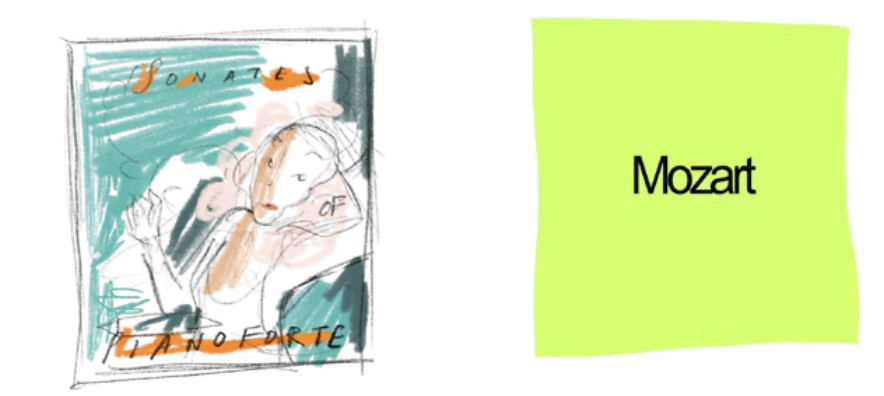
- Metadata Translation : Using annotations and marks made by the artists to reorganise this information.
- Translating new music identity into Classical forms: Using details like handwriting, old-style graphic details to represent the contemporary pop.
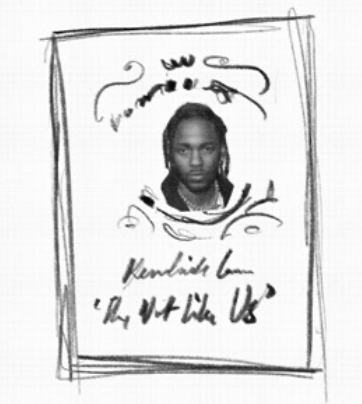
Change in Plans:
As I tried to classify this set through the filters above, I couldn’t find a critical enquiry compelling enough. Instead of trying to realise the documents in a contemporary form, I went back to the set and began going through the details.
I looked through the typeset (Eg. Use of Fraktur, in the reign of Germanic Composers) , to understand the visual flavour of the work – but still felt similar block as I did with the earlier ideas.
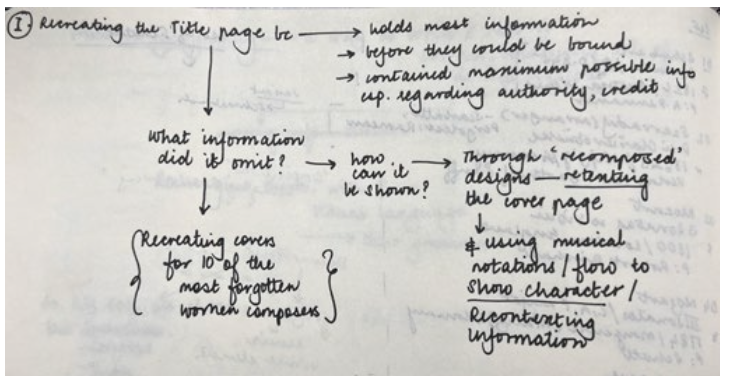
While I was zoning in on the details, I found the invisible subtext in the titles and found a detail which was glaringly obvious in hindsight, but something history had conditioned us to ignore: The lack of female composers on the list of authorship. This gave me a new angle to rework the data without losing the integrity of the original work.
Week 02
Continued Experimentation:
For the bulk of my process then, I focused on representing the histories of female composers in the Classical and Romantic period of Western Classical Music.
I shortlisted 8 Female Composers who had in part, or conditionally been disadvantaged through the history of music:
1. Marianna Martines
2. Elisabeth De Le Guerre
3. Louise Farrenc
4. Lili Boulanger
5. Fanny Mendelssohn Hensel
6. Amy Beach
7. Dora Pejačević
8. Augusta Holmes
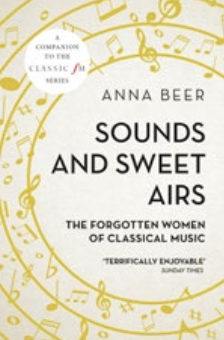
One of my key references in my research was Anna Beer’s Sounds and Sweet1 Airs, that explored the histories of female composers who went unheard.
This project found its critical enquiry through this iteration: it aims to recontextualise the glorious “title- pages” of the sheet music in the name of the few that were uncovered, especially the women who in part or completely had to give up their careers to meet the archaic expectations of womanhood, and recreates to immortalise their place among the classics.
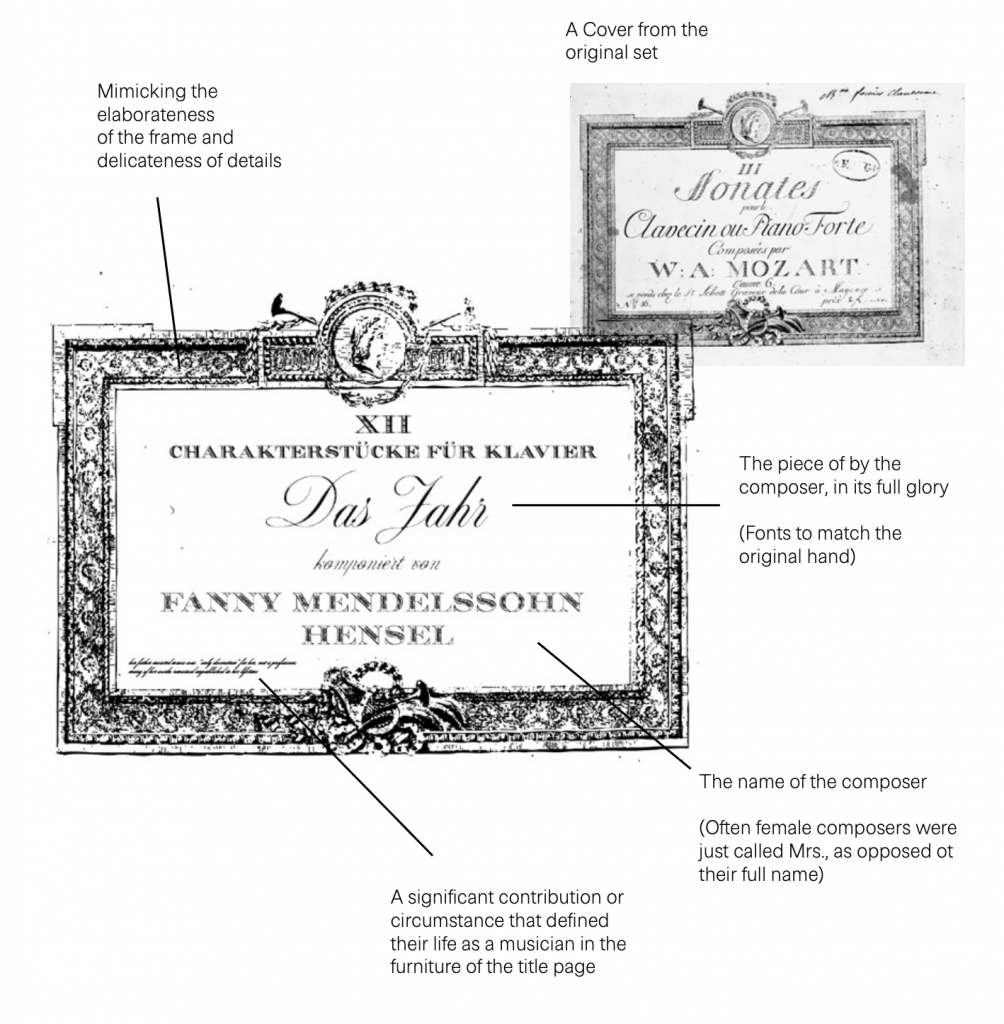
It felt full circle to use Graphic Communication Design to restore this lost piece of history and information as this gap had admittedly been created by graphic design as well.
A New Set for Female Composers
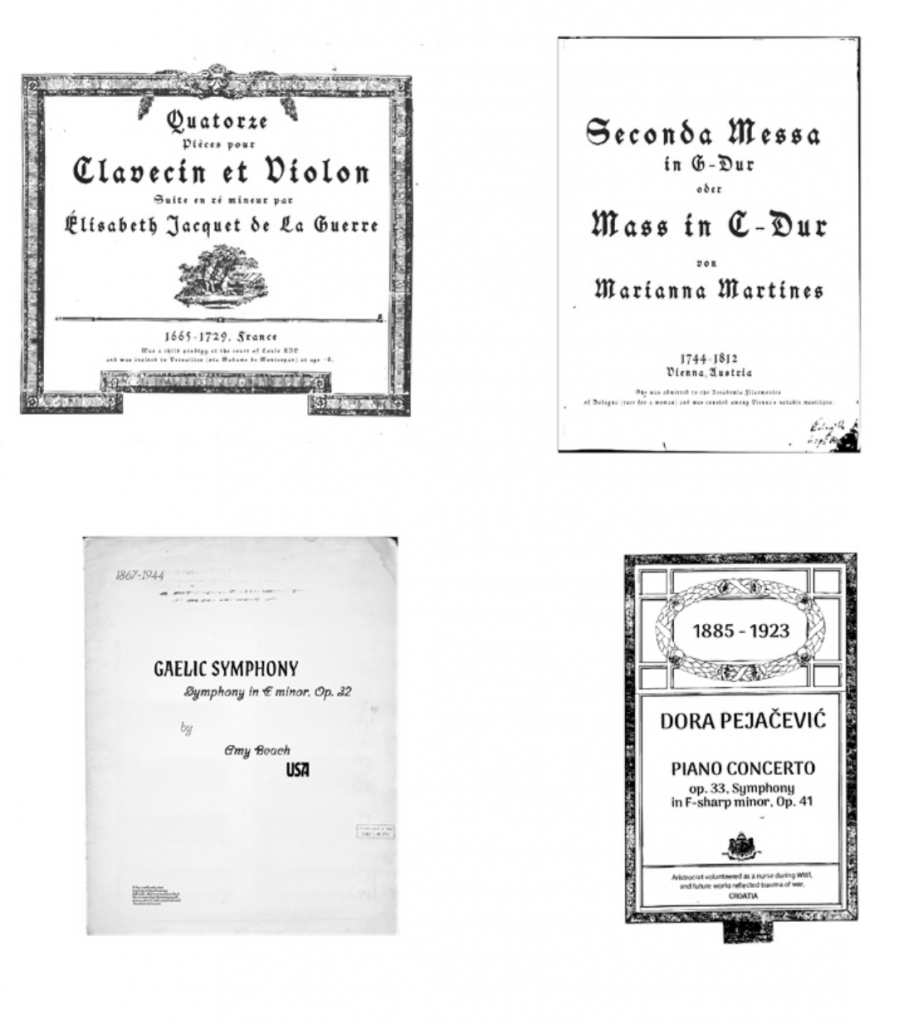
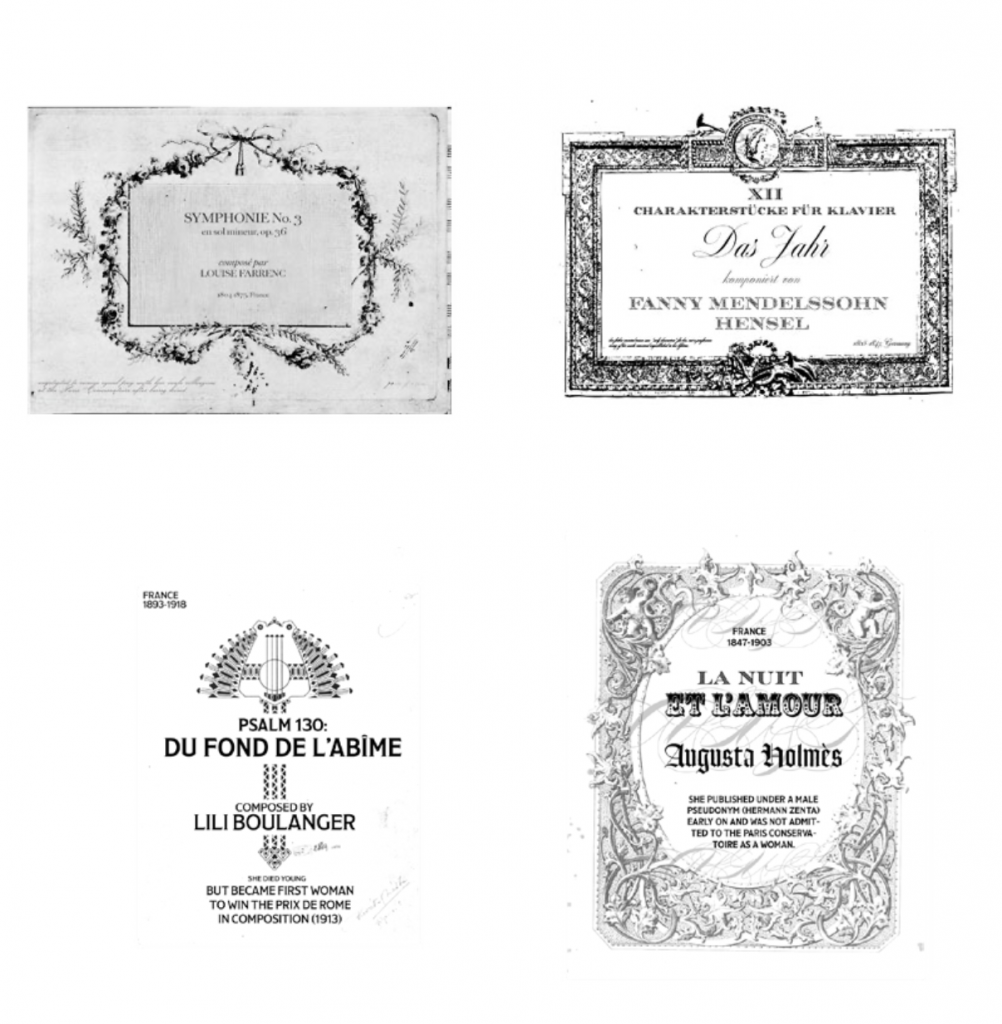
Developing the Titles in Books
A point that still bothered me in this enquiry was that I did not want to present a catalogue of the injustices that they suffered – instead honour them.
I decided to further the project by making small publications to carry that out, with the covers carrying details of their work and life.
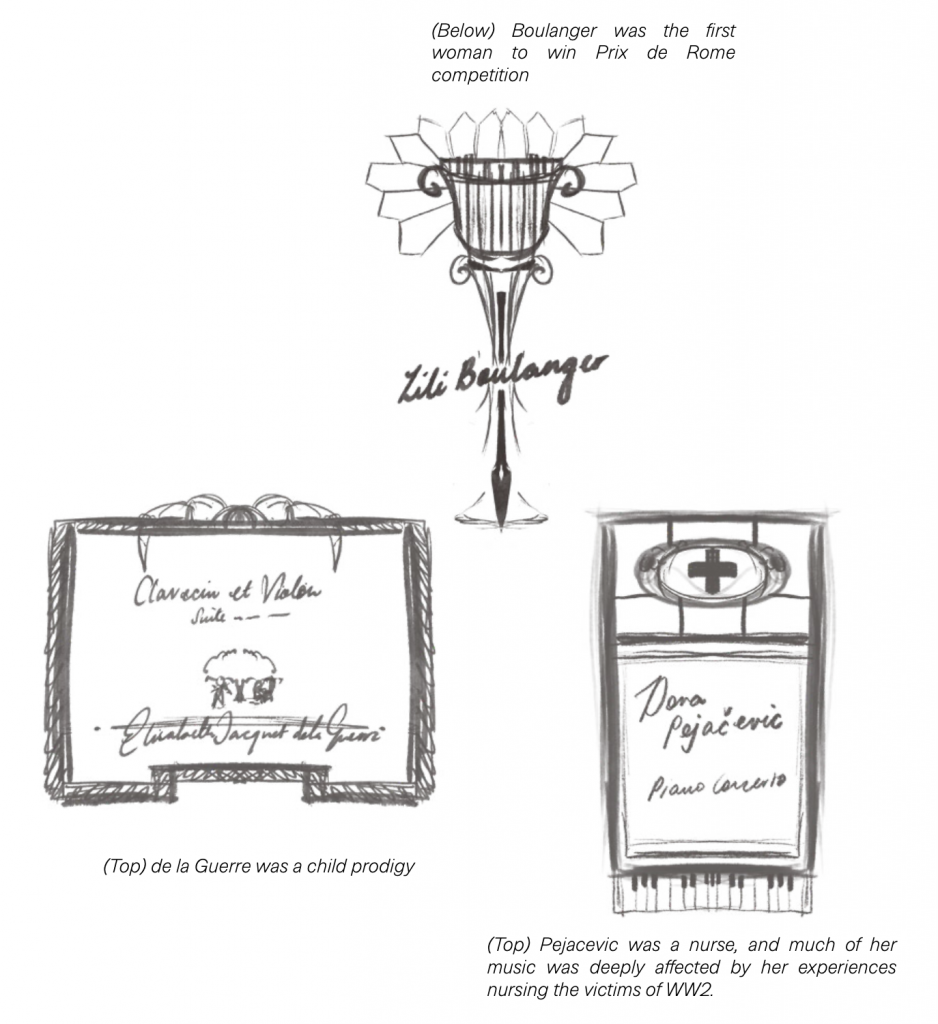
I tried to create some other ornamental covers based off their personality or merits, focussing on the main achievements of their lives, and the primary facet that shaped their careers.
Eg. Pejacevic (far-right illustration) was a Nurse, which heavily influenced her work, which I tried to represent with the red-cross mixed with the piano.
I focussed on maintaining their narrative within the visual language of the era, zeroing on Clara Schumann and Fanny Mendelssohn in the interest of time.
I wanted to honour Clara Schumann and Fanny Mendelssohn – and revisited their set through editing their title pages through the lens of their pieces and illustrated visualisations of their work – made while listening to their work.
1. Fanny Mendelsohn Hensel’s Das Jahr
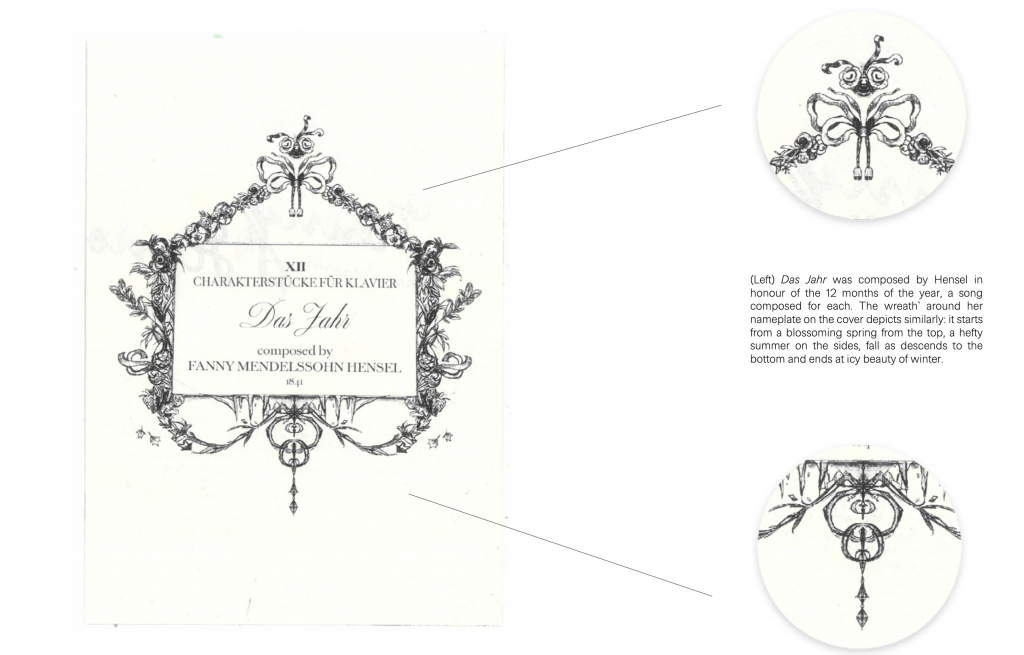
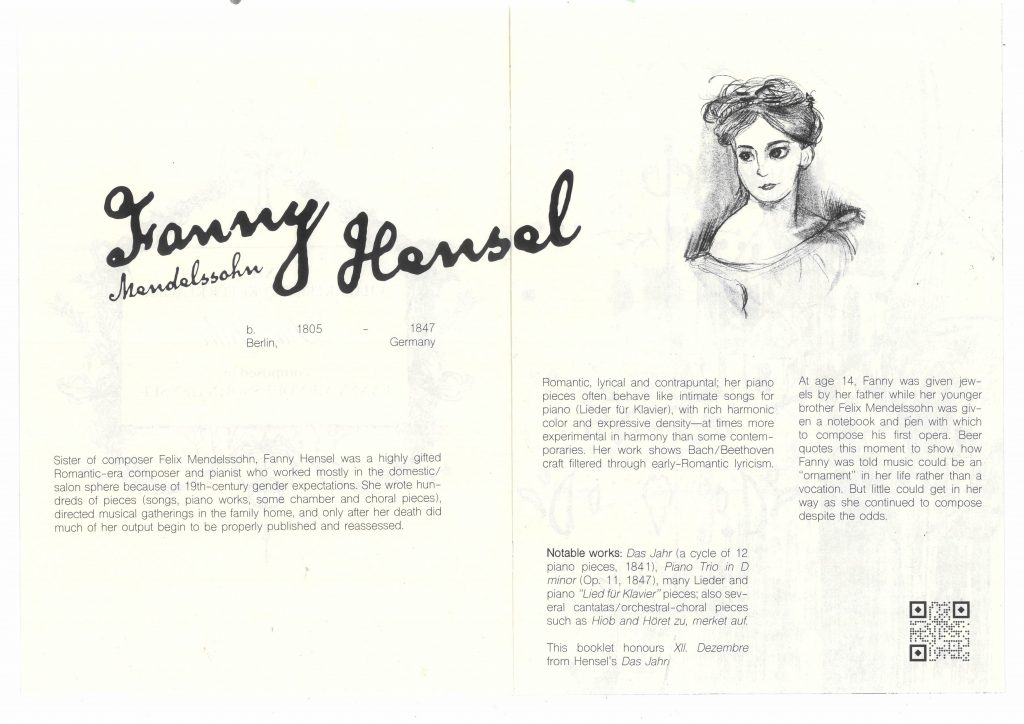
Her info-page covers her history, and a QR code sits at the
bottom, to scan and link to her music.
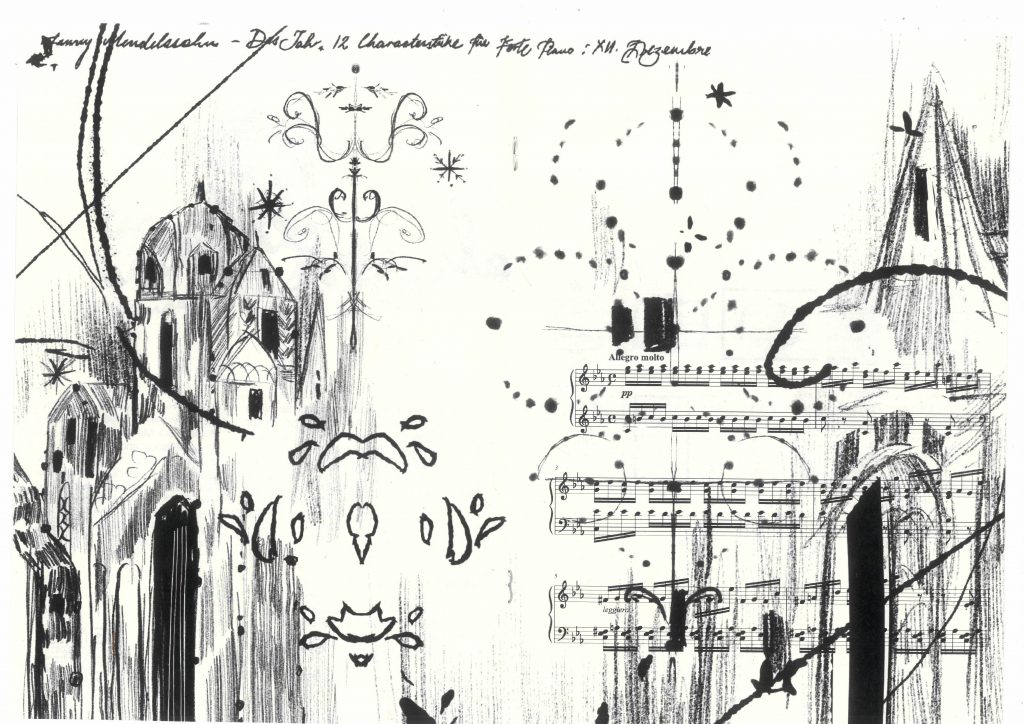
The illustration spread after her information page
visualises the last song of her album, December – through snowy
castles and delicate patterns of snowflakes. Although distinct from
the style of the cover, this becomes a effigy of how her music lives
on – even after all these years.
2. Clara Schumann’s Piano Concerto in A Min. Op. 7
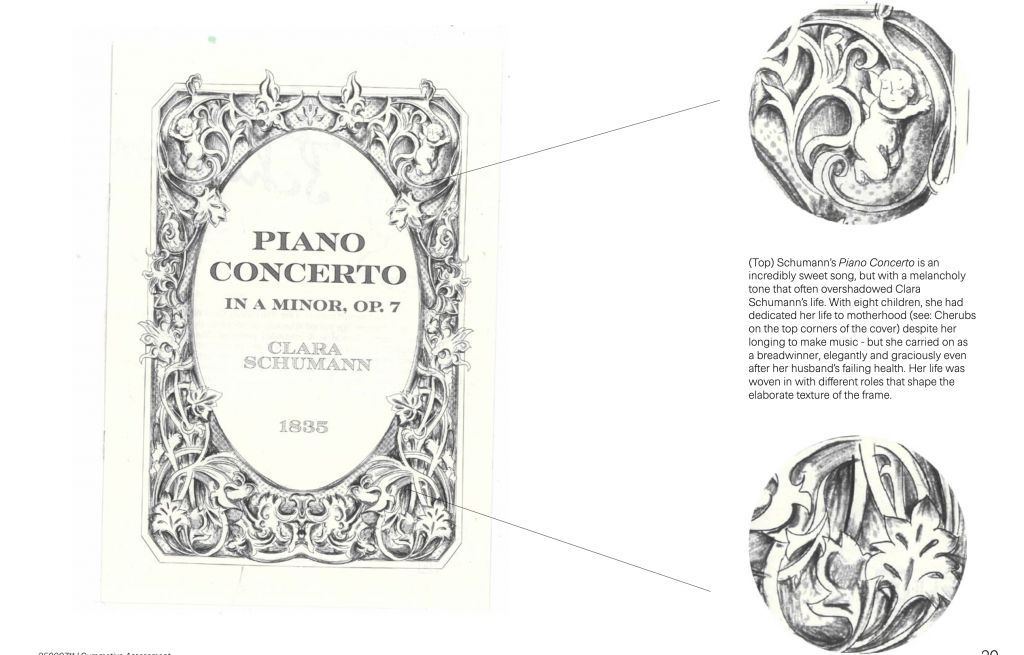
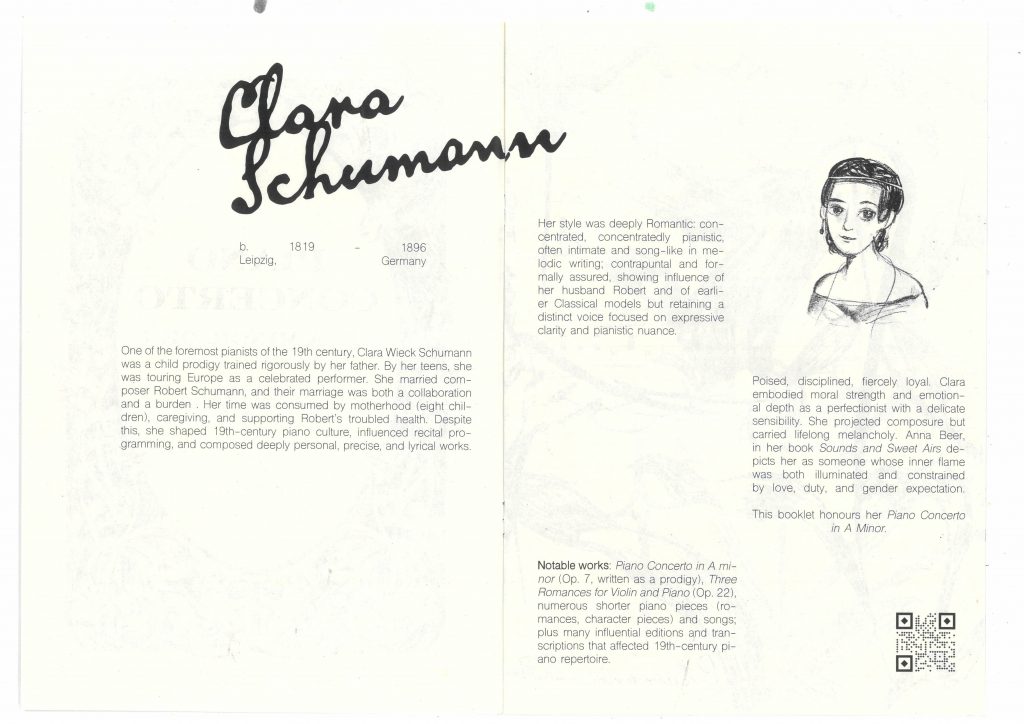
A page in the booklet expand on Clara’s life and the various
roles she took on. The QR code in the corner links to her work.
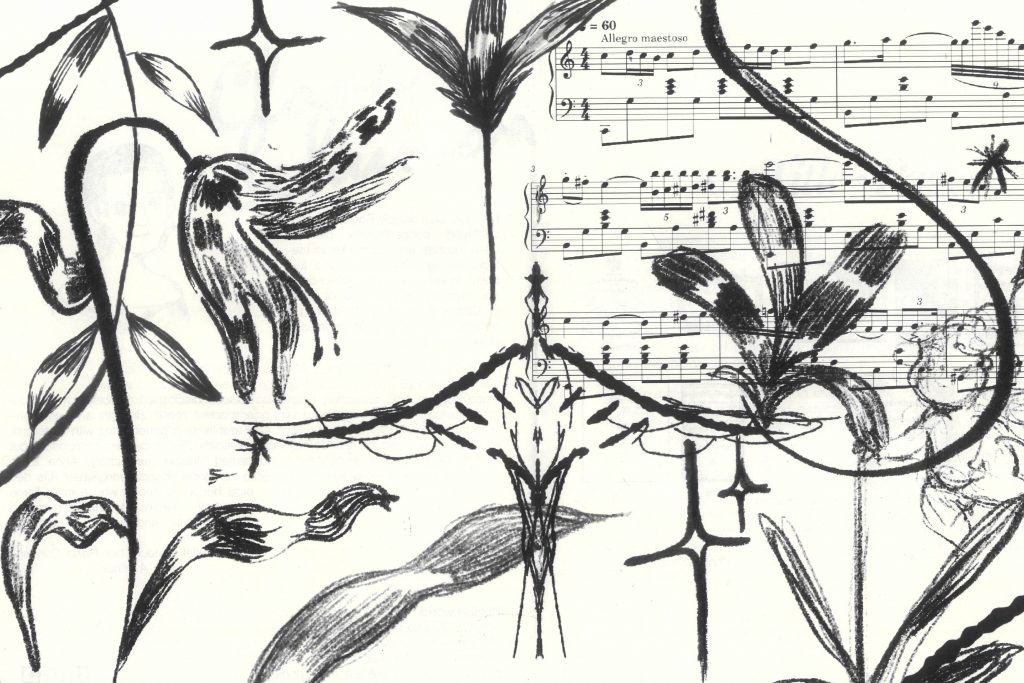
The illustration spread for Clara Schumann visualises her
want for freedom. There is elegance and mastery in her work, but
there was also the sadness of not being able to claim it.
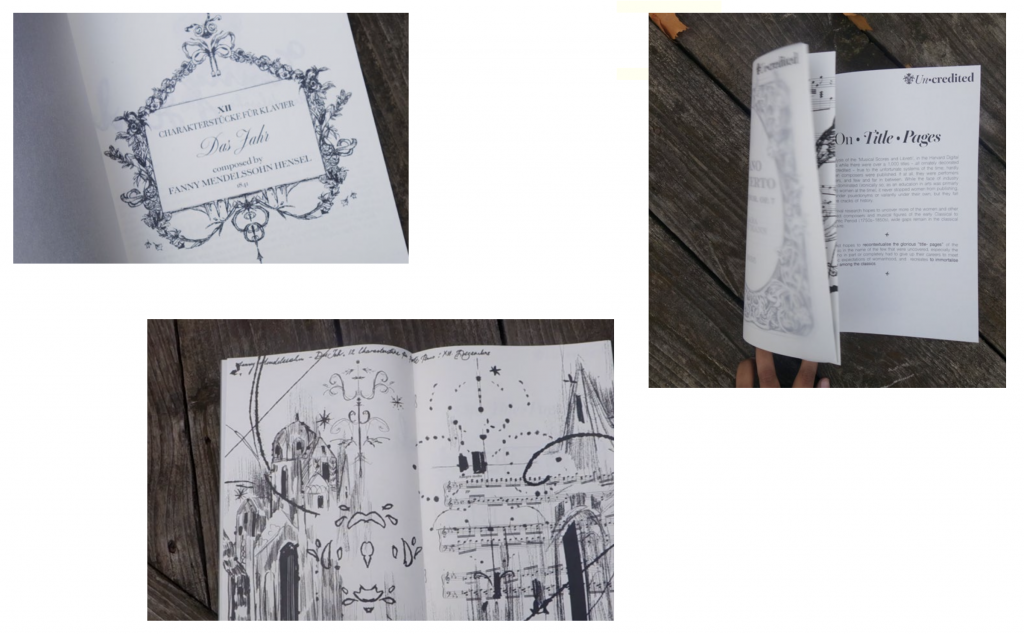
A layer of transparent paper covers the title-page and the back (the back is adorned with the large brocade motif of the project, shining in an ominous onyx tone) – and they protect the pages, while giving a glimpse into its contents.
A blurb “On Title Pages” sits on the last page, explaining the project enquiry and contextualising the work, connecting the pieces of the catalog with one another.
Updated Written Response:
- Beer, A.R. (2016). Sounds and sweet airs : the Forgotten Women of Classical Music. London: Onewor. ↩︎