
Assignment 03, Unit 01
Bureaucratic Chameleon: Shifting Identities on a Visa
Page of Contents:
Week 01
Getting Started
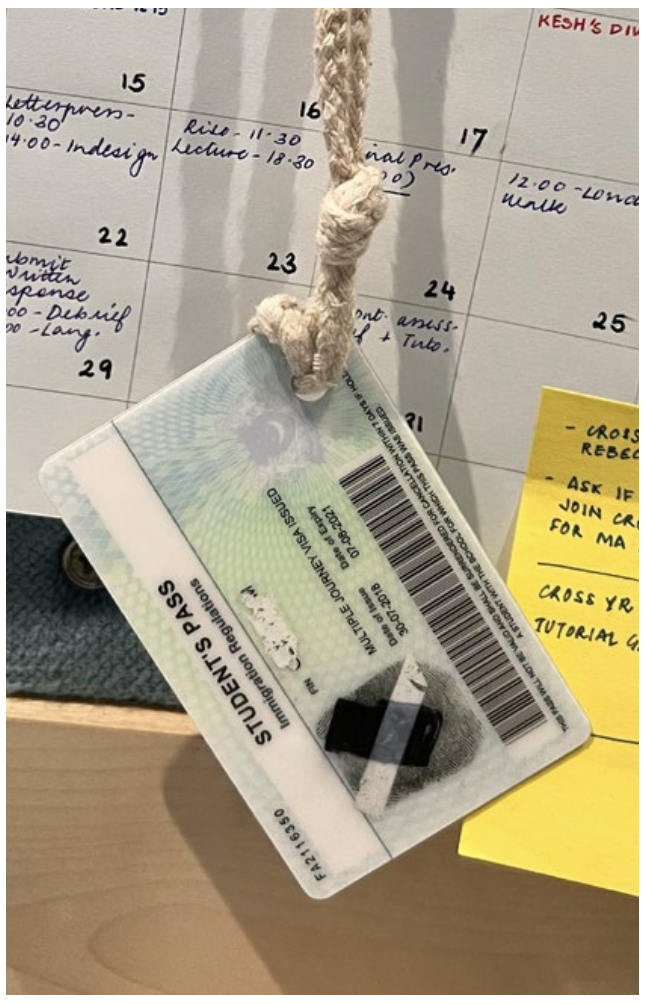
For methods of translating, I chose a topic that came to me most instinctively when I saw the ID card I now use as a bookmark hanging from my notice board.
For over 8 years, the ID Card – my residence pass- was secure in my wallet, ready to brandish at any given moment, and allowing me to reside and contribute in one of the strongest economies in today’s world- but now that it is past its validity, it has essentially become a relic and a toy.
For many immigrants, or ‘expats’ (if they are past a certain tax bracket), a visa is the hinge that gives them both freedom and keeps them in a captivity of sorts – gatekeeping movement and immigration and charging exorbitant amount of money to buy access.
While it is now customary for most nations to demand a visa to travel in their territory, who exactly is benefitting from this system?
There are many bureaucratic, national and security aspects to the machine that govern and regulate immigration – a lot that remain outside the scope of both this project and the knowledge of the common person – but its impact, that ripples most disproportionately in the Global South, is an indication of its imbalance of power.
For Methods of Translating, I wanted to explore the expansion of these clinical bureaucratic systems to the human experience of identities that hinge on documents that are subject to expiration.
Exploration
To begin this project, I began to collect personal anecdotes from family and friends on how much effort in time and money is required to apply for a visa, especially for an American, UK travel or residence visa – including medical and language tests, tickets and more, a lot of which was repetitive as the same requirements persisted for other visas.
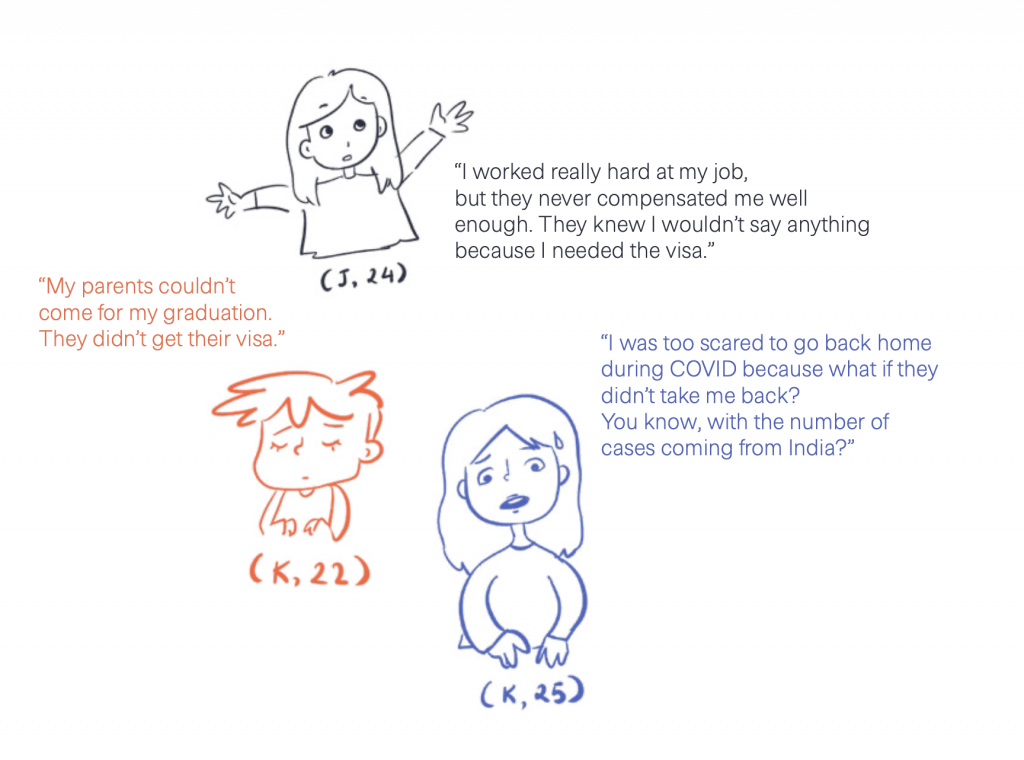
Besides the cost, there was the mention of the experience of constantly living under the threat of a deadline and the anxiety of a visa being cancelled – which is both stressful and sad, as friends and family part ways with lives they have created over the years.
I referenced “Visa inequalities:…‘You are not supposed to be here’” by Devran Gülel to advance my understanding of the geopolitical reality this topic – and he furthers the point of ‘Visa processes serving as tools of systemic exclusion that disproportionately affect Global South scholars and cause financial, psychological and temporal burdens.’ (Gülel, 2025). While he speaks mostly for academic exchange, it is alsoexperience and cultural exchange that suffers at the hands of privilege hierarchies created by geopolitics.
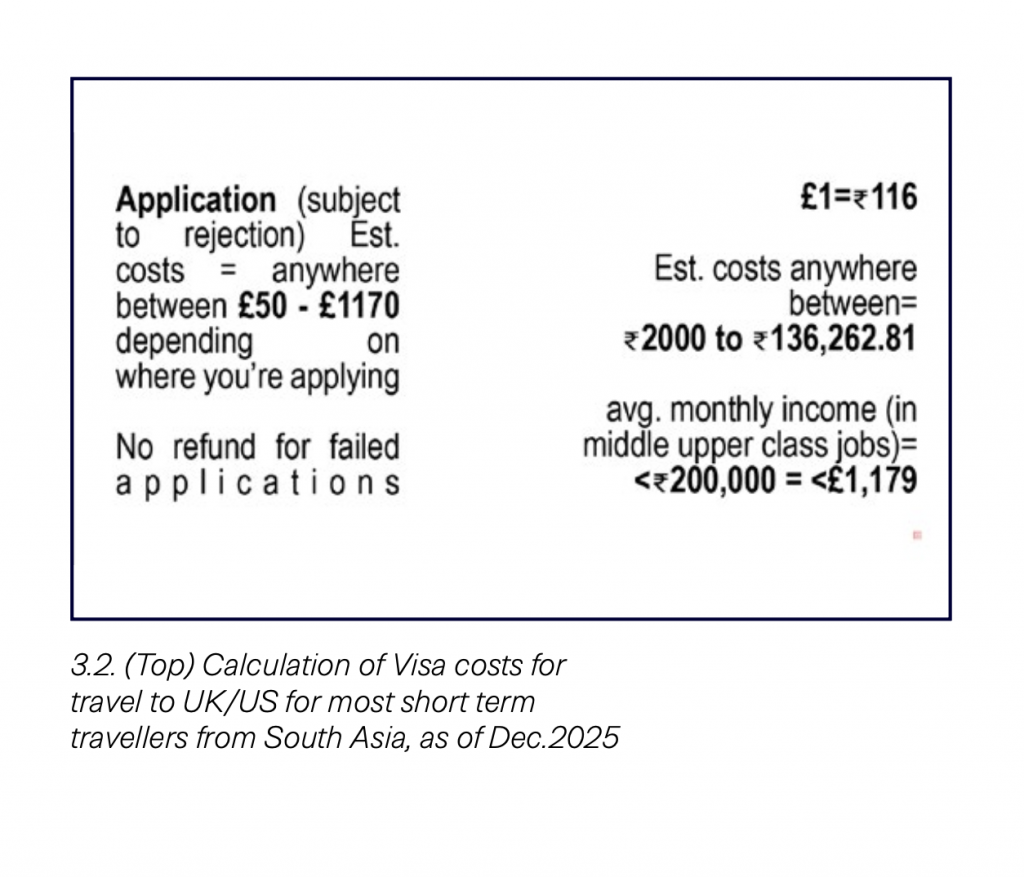
Gülel, D. (2025). Navigating visa inequities: mobility as privilege in academia – ‘You are not supposed to be here’. Global Social Challenges Journal, pp.1–10. doi:https://doi.org/10.1332/27523349y2025d000000050.
Experiment 01
My experiments began with translating the “semantics” and “visual language of bureaucracy into something deeply personal. How do you substantiate this document IC/ID Card? The identity card is reductive. It has very little information and far too much power. One of the first experiments was to create ID Card/ IC that is an elaboration of the smaller, standard one, which encapsulates and archives the human experiences that card allows.
The idea was on iterating on the visual identity of a card and keep annotating it till its full and exhausted.
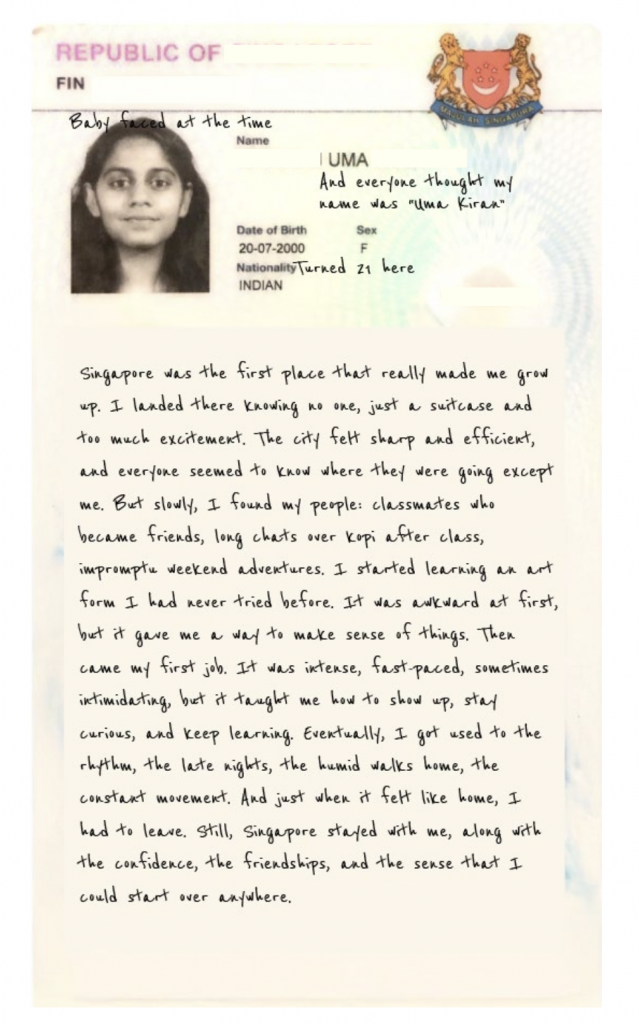
The IC / Visa extends into a longer document, that reveals a personal
anecdote about each ID card.
Experiment 02
As a piece of speculative design, what would an all-encompassing IC look like? Would it contain nationality? Age? Sex? Languages? This experiment teased the idea of identity being inexhaustible.
This card aimed to give maximum control to the person who the card to belonged to, instead of their place of origin, and transfer power to the person from the regime.
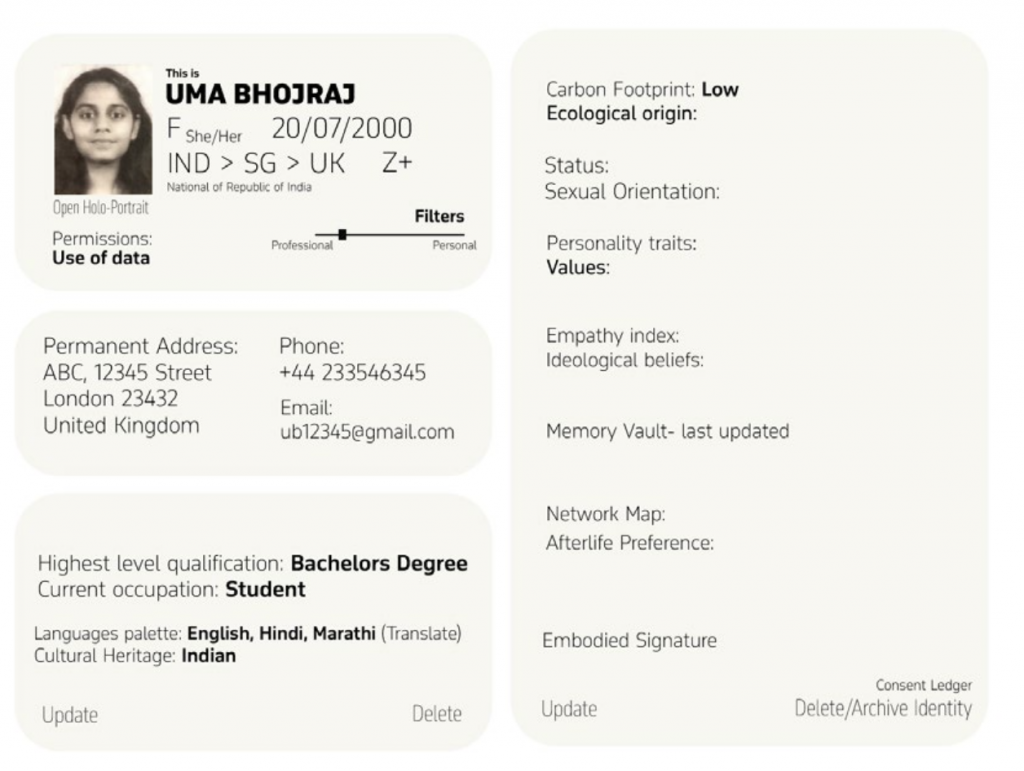
The Speculative IC (identity card) has all levels of filters so the identity can remain fluid as it is transported from one person to another.
Experiment 03
When the passport is not strong enough, even for short term travel visit, the visa application of certain nations demand personal information that almost feels invasive.
Citizenship becomes capitalist property (you can buy it and save yourself the troubles of the proletariat), and the passport becomes brand identity.
In this experiment, I wanted to create a full “general” / “first world” Visa application, annotating the file as I go with personal notes as I go. I wanted to create an application that encapsulates the ‘perfect’ resident / traveller.
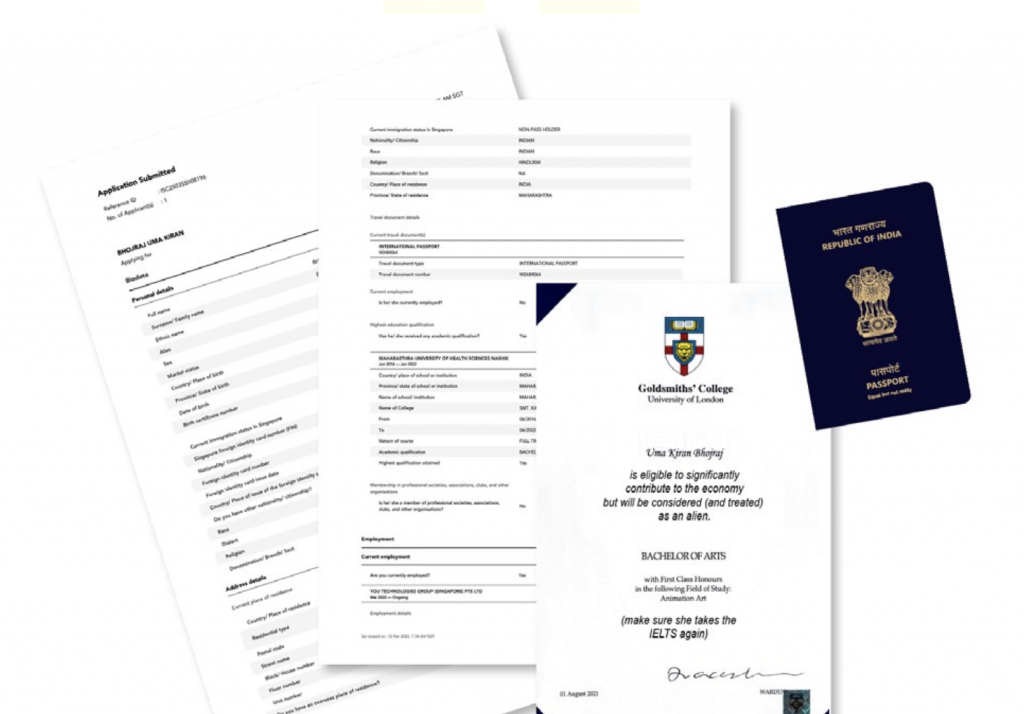
A filled Visa Application with annotations on the personal burdens
while going through the process – while re-captioning the documents with the subtext they carry (see: Passport and Degree)
Up Next
A lot of what I wanted to express was the injustice of being dehumanised by bureaucratic and immigration systems – especially in the treatment of the Global North / ‘First’ World when it brings in people from the Global South, so I decided to merge the materials with the personal and create an interface allows to expand that diminished identity – almost a mix of all three experiments.
Week 02
Process
Government websites often are notoriously glitchy, and almost obsolete in the way they are designed. But a lot of the process also depends on the slow, info-heavy websites – I wanted to replicate the jankiness of the interactions, so I used AI to help me write a rudimentary code for my interactive document to create 3 cards laid together. The interactions would then open handpainted illustration popups of the many things that constitutes life for them within that time (arguably one of the most “human” way of expression).
For my critical question, I wanted to make the process of this translation interactive by retaining the bureaucratic look that often diminishes identity to statics, which could achieved well through a simplistic website that holds a lot personal and rich information, but only reveals it when triggered.
One of my references was this brilliant game recommended by one of my groupmates, called Papers, Please. It is a puzzle simulation video game created by indie game developer Lucas Pope. The game was set in the Dystopian Arstotzka and the player is the immigration inspector controlling the flow of people entering the country. The aesthetics and tone of the game rouses empathy by demonstrating the cruel act of immobilising the flow of people in a war-ridden nation- it helped me place my juxtaposition of bureaucracy versus humanity.
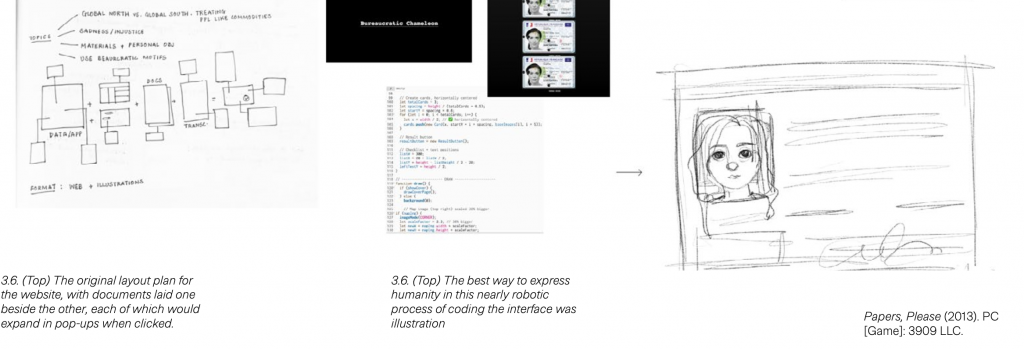
Development
After the basis of the interface was ready, a interaction of clicking into ID cards to reveal a pop-up that expands on the identity of the character, I created illustrations for the – more handdrawn, colourful and sketchy, with a sense of motion and imperfection within them so they stand against the frigidity of the backdrop well.
I started annotating the cards with recurring thoughts that define ‘identity’ for an immigrant or expat, which is often marked with urgency and an expiry date, over anything else.

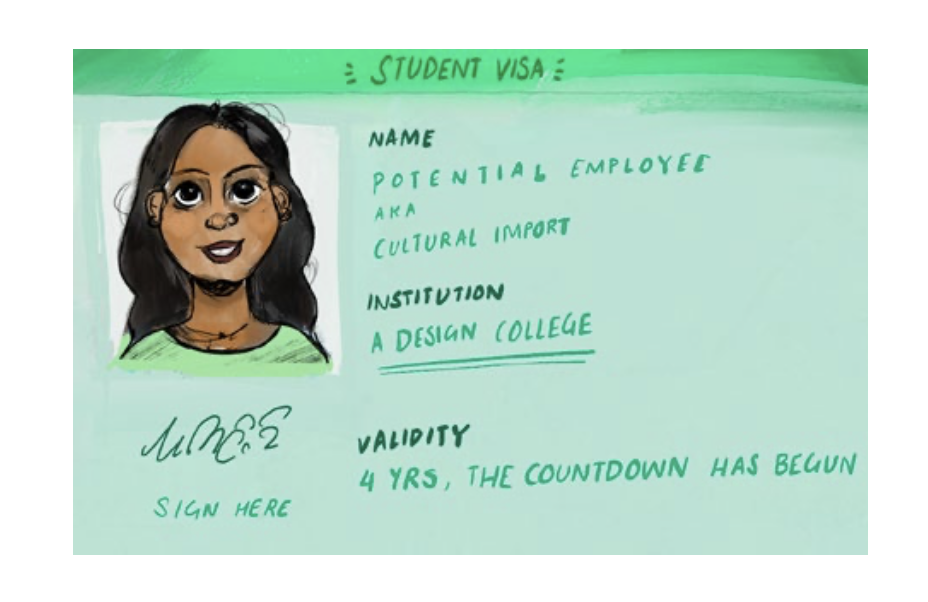
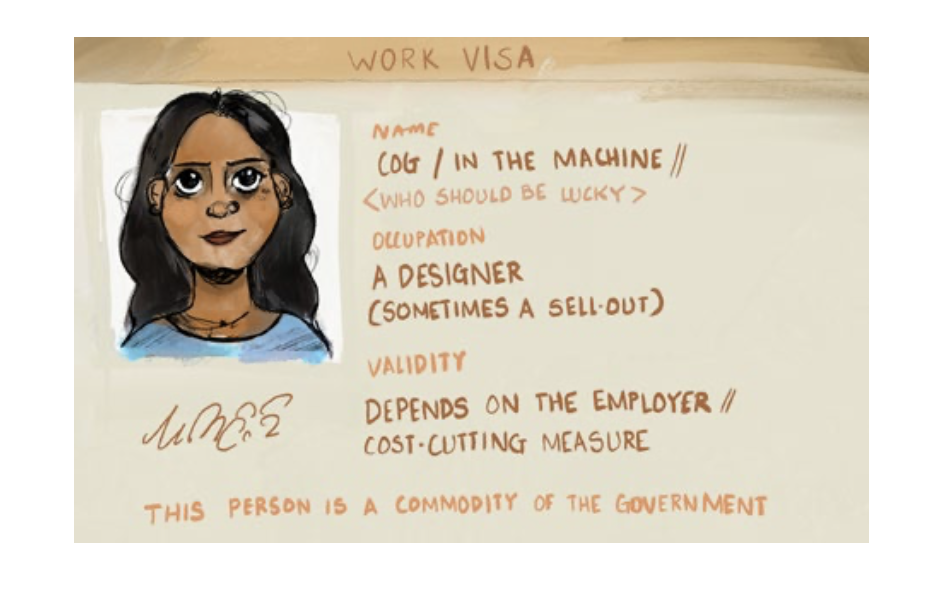
The base ID cards (progressively) each show a phase in the life of the “immigrant” and the supporting images ellaborate on their lives.
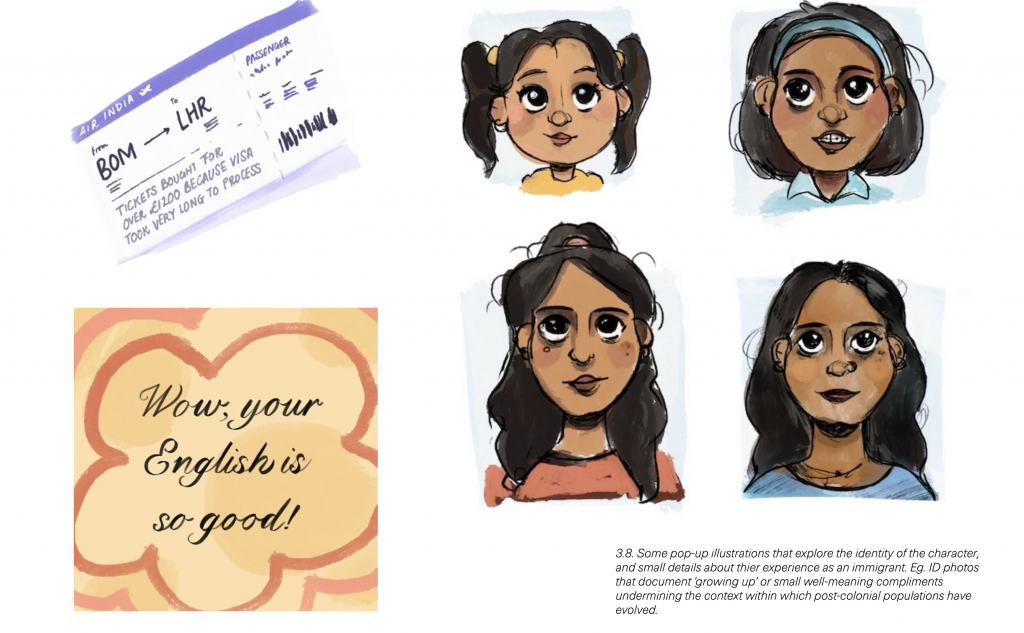
Some pop-up illustrations that explore the identity of the character,
and small details about their experience as an immigrant. Eg. ID photos
that document ‘growing up’ or small well-meaning compliments
undermining the context within which post-colonial populations have
evolved.
Showcase
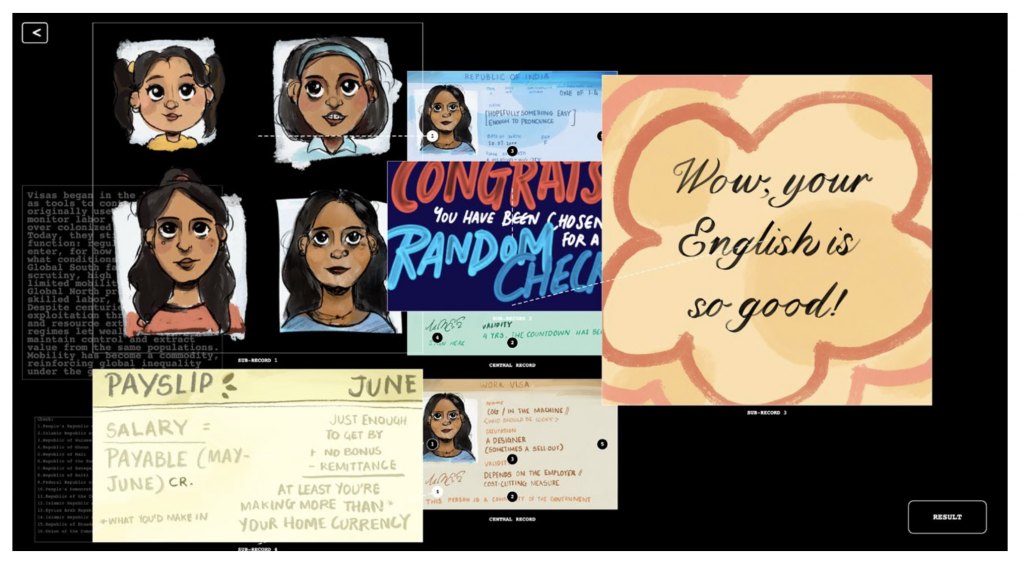
The cover page leads us into the layout of 3 cards with numbers around them – and clicking into the numbers explodes the page into several pop-ups. The identity cards expand into multitudes of aspects, all a different phase, a new shape, created by the experiences that are condensed within the control of a single document.
See full video recording here.
See site here.
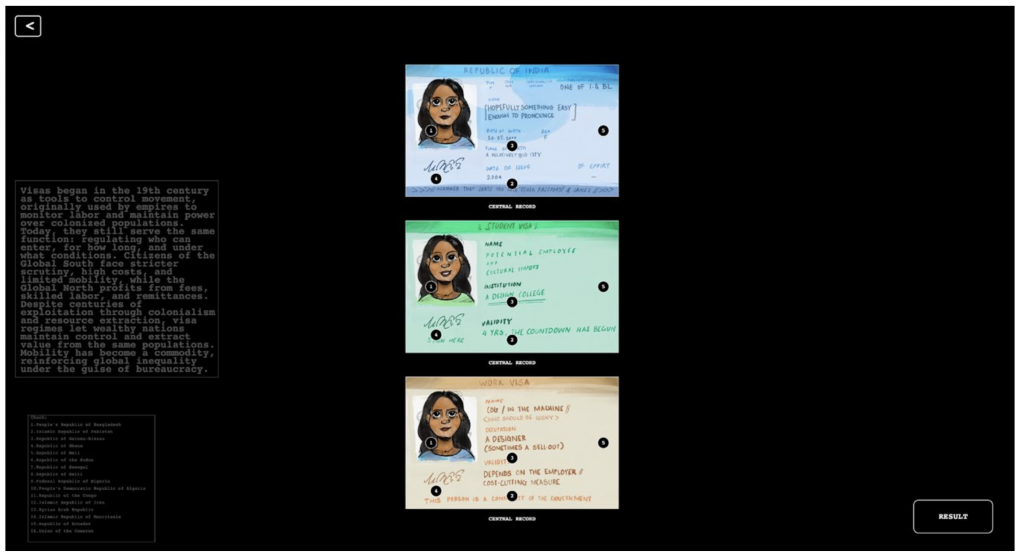
The clicking interaction creates a mechanical sound: a print, a process of bureaucracy being expanded. At the bottom right corner, a ‘result’ button sits, which if pressed randomly creates an Approved/Denied message – quite similar to how random the process is for most people who never know on what ground their visas applications were given the result it were – so the anxiety loop continues.
End Notes
On this enquiry:
Through this project, I was able to carry out an enquiry regarding the geopolitical realities of mobility for residents from the Global South and the ease of access bias possessed and protected by parts of the Global North. Using illustration and art revives the humanity that is disregarded in the broad census and categorisation of nations, and brings back empathy in these discussions.
However, the topic is wider and deeper than this enquiry, and while reading the impact is one way to respond to the topic, there still remains a power gap between the privileged few travelling with some means (as the ones illustrated here) versus those who migrate to survive. This enquiry acknowledges that and I hope there would be more opportunity for me in the future to expand on the nuances of immigration and challenge the colonial bias such as this through my work.
On Future Development:
To further develop this project, I am interested in cleaning up the scope of this enquiry to focus more deeply on the discussions around the impact of border and privilege hierarchies in geopolitical realities of the Global South through subtext.
On a technical level, I would like to push the project to be clearer and easier to navigate while maintaining its sense of “explosion”.
Updated Writing Response:
-x-
Leave a Reply